Your Trusted Electrical Knowledge Partner

Uninterruptible Power Supply (UPS): Types, Working Principle, Components, Applications, Selection, and Future Trends
A quick guide to UPS covering its types, working principle, components, applications, selection tips, and future trends.
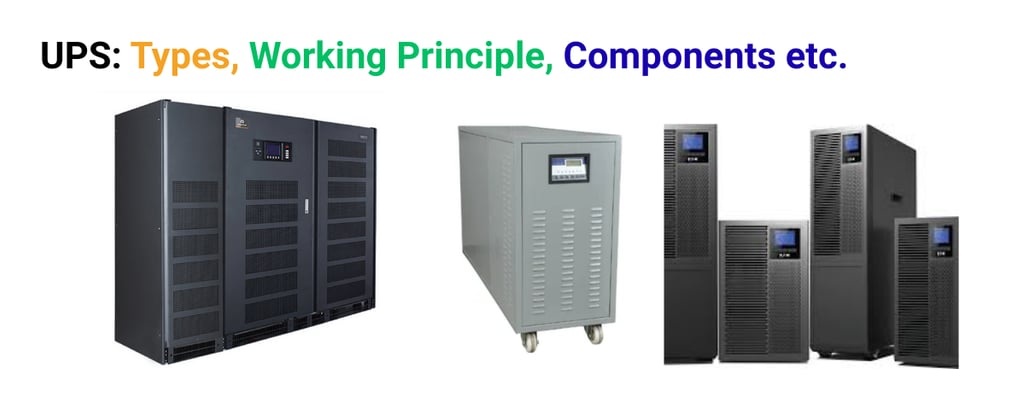
Uninterruptible Power Supply (UPS): Types, Working Principle, Components, Applications, Selection and Future Trends
Introduction:
Electric power is the backbone of modern life. From household electronics to industrial automation and data centres, almost every critical system depends on a continuous and stable power supply. However, electrical power is not always reliable. Power failures, voltage fluctuations, surges, and electrical noise are common problems that can damage equipment, interrupt services, and cause significant financial losses.
To solve these issues, Uninterruptible Power Supply (UPS) systems are widely used. A UPS ensures that electrical equipment continues to receive power, even when the main supply fails or becomes unstable. Unlike backup generators, a UPS provides power instantly, without any delay, making it essential for sensitive and mission‑critical applications.
What is a UPS?
A UPS (Uninterruptible Power Supply) is an electrical system designed to provide immediate backup power and power quality improvement when the input power source fails or falls outside acceptable limits. The main objectives of a UPS are:
To supply uninterrupted power during short‑term outages
To protect equipment from voltage sags, spikes, and electrical noise
To allow safe shutdown of systems during extended power failures
To improve overall reliability and availability of electrical installations
UPS systems are commonly used with computers, servers, Data centers, HUB rooms, BMS rooms, medical equipment, industrial control systems, telecom networks, and security systems.
Why UPS is Important in Electrical Systems
Modern electronic equipment is highly sensitive to power disturbances. Even a brief interruption of a few milliseconds can reset digital circuits, corrupt memory, or stop critical processes. A UPS plays a vital role by acting as a power buffer between the utility supply and the load.
Key benefits of using a UPS include:
Prevention of data loss
Protection against equipment damage
Reduction in downtime
Improved system reliability
Enhanced safety for users and processes
Basic Working Principle of a UPS
The working principle of a UPS is based on energy storage and power conversion. Under normal conditions, the UPS receives power from the mains, conditions it if required, and supplies it to the connected load. At the same time, it keeps its energy storage system(Battery banks) fully charged.
When the input power fails, the UPS automatically switches to its stored energy source and continues supplying power to the load without manual intervention.
In general, the operation involves three stages:
Conversion of AC input power into DC power
Storage of energy in batteries
Conversion of DC power back into AC power suitable for the load
Depending on the UPS type, this conversion may be continuous or occur only during outages.
Main Components of a UPS
A UPS system is made up of several important components, each serving a specific function.
Rectifier and Charger: The rectifier converts incoming AC power into DC power. This DC power is used to: Supply the inverter and Charge the battery bank
The charging circuit ensures proper charging and prevents overcharging or deep discharge of batteries.
Battery System: The battery is the energy storage element of a UPS. It stores electrical energy in chemical form and delivers DC power when the input supply fails. The capacity of the battery determines the backup time provided by the UPS. Common battery types include lead‑acid and lithium‑ion batteries.
Inverter: The inverter converts DC power from the battery into AC power that can be used by electrical equipment. A good inverter provides stable voltage, constant frequency, and a clean sine‑wave output.
Static Switch and Bypass: A static bypass switch automatically transfers the load to mains supply during a UPS fault or overload, ensuring uninterrupted power (safe failure to mains).
During bypass operation, the UPS power path (rectifier, batteries, inverter) is bypassed, so power is not filtered or conditioned.Maintenance Bypass Mode: It routes the critical load directly from the utility mains through an external Maintenance Bypass Breaker (MBB), fully isolating the UPS power path.
In this condition, the rectifier, inverter, and battery system are disconnected, and no backup or power conditioning is available.
This mode is used to safely perform UPS maintenance or replacement without interrupting the connected load.Control and Monitoring System: This system monitors parameters such as voltage, current, temperature, battery status, and alarms. It also manages protection features and communicates system status to users.
Types of UPS Systems:
UPS systems are classified based on their operating principle and level of power protection.
Offline UPS (Standby UPS) : An offline UPS is the simplest and most economical type. Under normal conditions, the load is supplied directly from the mains. When a power failure occurs, the UPS switches to battery mode and begins supplying power through the inverter. Offline UPS systems are suitable for applications where short interruptions are acceptable and power quality requirements are not very strict.
Line‑Interactive UPS : A line‑interactive UPS improves upon the offline design by incorporating automatic voltage regulation. It can correct minor voltage fluctuations without switching to battery mode. This type of UPS offers better protection and longer battery life compared to offline UPS systems and is commonly used for office equipment and network devices.
Online UPS (Double Conversion UPS) : An online UPS provides the highest level of protection. In this system, the input power is always converted into DC and then back into AC before being supplied to the load. As a result, the load is completely isolated from mains disturbances. Online UPS systems have zero transfer time and are ideal for critical applications such as data centers, hospitals, and industrial automation systems.
UPS Capacity and Power Rating :
UPS ratings are generally specified in VA (Volt‑Ampere) or kVA, rather than watts. This is because UPS systems must handle both real power and reactive power. The actual usable power depends on the power factor of the connected load. A proper calculation of load requirements is essential to avoid overloading and premature failure of the UPS.
UPS Batteries and Their Role
The battery is one of the most critical parts of a UPS system. Its performance directly affects backup time and system reliability. Common battery technologies used in UPS systems include:
Valve‑regulated lead‑acid batteries
Flooded or tubular lead‑acid batteries
Lithium‑ion batteries
Nickel‑cadmium batteries
Battery selection should consider factors such as backup time, operating temperature, maintenance requirements, size, weight, and expected service life.
Applications of UPS Systems
UPS systems are used across a wide range of industries and environments.
In IT and data centers, UPS systems protect servers, storage devices, and networking equipment from sudden shutdowns.
In hospitals and healthcare facilities, UPS ensures continuous operation of life‑support equipment, diagnostic machines, and laboratory instruments.
In industrial plants, UPS systems support control panels, PLCs, and automation systems, preventing process disruptions.
In telecom and networking, UPS maintains uninterrupted communication and data transfer.
In commercial and residential applications, UPS systems protect computers, CCTV systems, routers, and home office equipment.
Selecting the Right UPS
Choosing the right UPS requires careful evaluation of several factors:
Total power requirement of the load
Desired backup time
Sensitivity of equipment
Input and output voltage requirements
Single‑phase or three‑phase configuration
Environmental conditions
Expandability and redundancy needs
Proper sizing and selection improve reliability and reduce operating costs.
Maintenance of UPS Systems
Regular maintenance is essential to ensure long life and reliable operation of UPS systems. Important maintenance practices include:
Inspection of battery condition
Checking electrical connections
Monitoring temperature and ventilation
Testing backup operation periodically
Keeping firmware and monitoring systems updated
Neglecting maintenance can lead to unexpected failures during critical situations.
Advantages of Using UPS
Some major advantages of UPS systems are:
Instant power backup
Protection from power disturbances
Improved equipment lifespan
Reduced downtime and losses
Safe system shutdown during extended outages
Limitations of UPS Systems
Despite their benefits, UPS systems have certain limitations:
Limited backup duration
Battery replacement costs
Space and cooling requirements
Higher initial investment for online UPS systems
Understanding these limitations helps in creating a balanced power backup solution.
Future Trends in UPS Technology
UPS technology is continuously evolving to meet growing power demands. Some important future trends include:
Increased use of lithium‑ion batteries
High‑efficiency and eco‑friendly designs
Smart UPS systems with remote monitoring
Modular and scalable UPS architectures
Integration with renewable energy systems